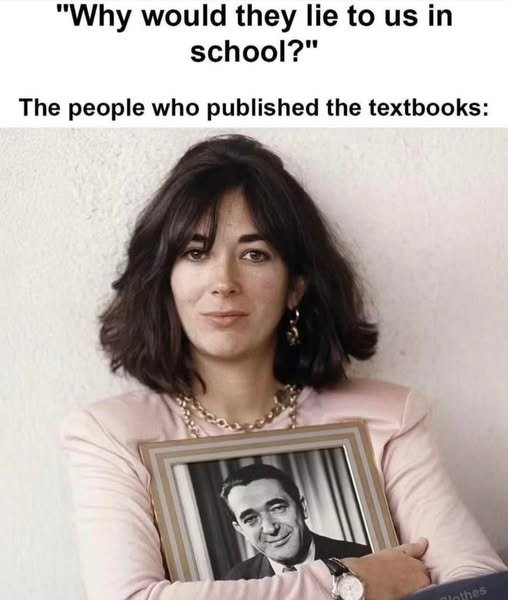
Few people realize that the infamous Ghislaine Maxwell, later tied to Jeffrey Epstein, came from a family dynasty deeply rooted in the world of publishing.
Her father, Robert Maxwell, was no ordinary businessman.
He was a towering figure in postwar Europe, a man who built an empire out of paper, ink, and knowledge.
In 1960, Maxwell founded Pergamon Press, a publishing house that specialized in the lucrative fields of science, technology, and medicine.
These were not storybooks or novels.
They were the weighty textbooks and academic journals that shaped the very foundations of higher learning for a generation.
Universities, laboratories, and research institutes around the globe bought what Pergamon sold.
Maxwell’s reach grew so vast that by the late 1980s, Pergamon Press had become one of the most influential textbook companies in the world.
In 1989, he struck a powerful deal with McGraw-Hill, forming a joint venture that created the second-largest textbook publisher in the United States.
For students across America, the knowledge in their classrooms often flowed through Robert Maxwell’s business empire.
This was not just about selling books.
It was about controlling the flow of scientific and academic information at the highest levels.
But Robert Maxwell’s power did not come only from publishing.
For decades, there have been persistent reports that he had deep ties to foreign intelligence services.
British, American, Soviet, and Israeli agencies have all been linked to him in various ways.
In particular, multiple investigations and biographies point to his close relationship with Mossad, Israel’s intelligence agency.
Former intelligence officers have suggested that Maxwell acted as a go-between, helping Mossad with influence operations and possibly even with arms deals.
One allegation is that he assisted in distributing PROMIS software, a powerful surveillance tool that was allegedly modified to allow spying on governments and corporations worldwide.
His vast publishing empire gave him the perfect cover to mingle in elite circles, rubbing shoulders with politicians, academics, and world leaders while passing sensitive information across borders.
After his mysterious death in 1991, falling from his yacht, the Lady Ghislaine, members of Parliament described him as a man who lived a life of “lies and deceit.”
Declassified records suggest intelligence agencies kept close tabs on him, and some accounts claim he was more than an observer, that he was an active participant in covert operations.
Whether asset, collaborator, or simply a man with too many secrets, Maxwell’s life was entangled with the shadow world of espionage.
Even the name of his publishing house carries an eerie weight.
The company was called Pergamon Press, named after Pergamon (or Pergamum), an ancient Greek city in what is now modern-day Turkey.
Pergamon was once a great center of learning, famous for its vast library and its role as a hub of knowledge in the classical world.
Yet in the Book of Revelation, Pergamon is singled out as one of the Seven Churches of Asia.
It is described not only as a city of learning, but as the place “where Satan’s seat is.”
A city that had once prided itself on wisdom and scholarship was marked in Scripture as a place of corruption, temptation, and darkness.
So here we have Robert Maxwell, a man who controlled textbooks for millions, tied to intelligence agencies, and who named his empire after a city linked in the Bible to the throne of Satan.
He died under mysterious circumstances, his empire collapsed in scandal, and his daughter Ghislaine would later carry forward a legacy of infamy through her role in one of the darkest scandals of our age.
History leaves clues.
And sometimes the names themselves tell you more than you ever wanted to know.
0 Comments