
Don't Ignore Preperation Because You Feel Helpless!
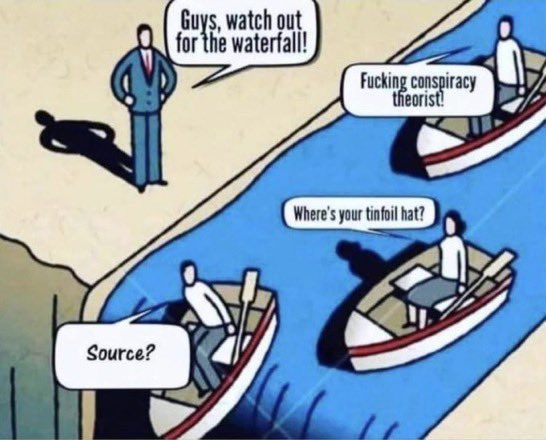
We all deal with Biases everyday and don't give them much thought. That however doesn't mean they are not affecting us, quite to the contrary actually. When we allow our Biases to Run it allows our System to get out of Flight or Flight mode and ignore potential threats right in our faces. This can be good most of the time, however, you can think of it like the Boy who cried wolf. When there is something we need to pay attention too, we don't to our determent because we have used our Biases to Rationalize away what we don't like. This way we can Avoid dealing with it, unless we can't, which means we should have paid attention to the warning signs before instead of blowing them off.
We have been Lied too all of our lives about everything. REALLY EVERYTHING! I will put up some of the lies in the videos and images below. This is our most Darkest Hour and it is very Late in the Day. Be Ready For Anything! Watch Mike Adams Below to Understand this Warning further.
The same tactics used by governments and religions to Control —propaganda, control, or myth-making. The parallels reveal how belief systems are reinforced by shaping perception, suppressing dissent, and anchoring group identity.
- Anchoring Bias
Definition: The tendency to rely heavily on the first piece of information received (the “anchor”) when making decisions or forming beliefs.
- Religious Use: Children are taught early that “God exists,” “the Bible is true,” or “Jesus is your Savior.” These become default assumptions that shape all future interpretation of evidence.
- Governmental Use: National myths are taught in childhood education, anchoring all future views on government or history. (e.g., “the greatest democracy,” or “Our founding is divinely inspired”)
- Confirmation Bias
Definition: The tendency to search for, interpret, and remember information that confirms one’s existing beliefs.
- Religious Use: Believers often see answered prayers as proof of God, while rationalizing unanswered ones. Bible verses are selectively cited to “prove” doctrines already accepted.
- Governmental Use: Media or state institutions emphasize stories that confirm national righteousness while omitting critical narratives (e.g., war crimes, surveillance abuses).
- Authority Bias
Definition: Placing undue trust in the opinions of perceived authority figures.
- Religious Use: Pastors, priests, or scriptures are treated as infallible. Questioning them is considered heretical and immoral.
- Governmental Use: Presidents, generals, or founding fathers are elevated to unquestionable status. “Support the troops” becomes a silencing slogan, not a moral reflection.
- In-group Bias / Tribalism
Definition: Favoring people who belong to one’s group while viewing outsiders with suspicion or hostility.
- Religious Use: “We are God’s chosen.” Non-believers are “lost,” “immoral,” or “going to hell.” Community reinforces belief through social and emotional bonds.
- Governmental Use: Nationalism is the political version of this bias. Foreigners, immigrants, or “the opposition” are framed as threats to identity, safety, or tradition.
- Cognitive Dissonance
Definition: The mental discomfort of holding two conflicting beliefs or confronting evidence that contradicts a core belief.
- Religious Use: When believers encounter contradictions in scripture or suffering in life, they rationalize it (“God works in mysterious ways”) rather than confront doubt.
- Governmental Use: Citizens who see injustice by their country (e.g. war, corruption) may downplay it (“But we’re still the freest country on Earth”) to reduce discomfort rather than act.
- Status Quo Bias
Definition: A preference for things to stay the same, or resistance to change—even when evidence suggests the current state is flawed.
- Religious Use: Traditional doctrines are protected by appeals to "sacred tradition," even if modern morality contradicts them.
- Governmental Use: Politicians often appeal to “patriotic tradition” to resist social reforms, even when such reforms address injustice or inequality.
- Availability Heuristic
Definition: Overestimating the importance of information that comes to mind easily, usually due to vividness or recent exposure.
- Religious Use: A single "miracle story" or emotional conversion testimony may overshadow a lifetime of mundane or contradictory experiences.
- Governmental Use: Politicians highlight vivid events (e.g. terrorist attacks) to justify sweeping policies (e.g. surveillance laws, foreign wars), even if statistically rare.
- Appeal to Consequences / Motivated Reasoning
Definition: Accepting a belief not because it's true, but because it's comforting or has desirable outcomes.
- Religious Use: Belief in heaven is emotionally comforting, and that comfort makes believers more resistant to questioning the reality of it.
- Governmental Use: “Our freedom depends on supporting this war” or “Our prosperity depends on this system” are used to silence criticism—even if the policy is harmful or unjust.
- Sunk Cost Fallacy
Definition: Continuing to invest in something because you’ve already invested time, money, or emotion—even if it's no longer rational.
- Religious Use: “I’ve believed in God all my life” or “I’ve raised my kids Christian” becomes a reason to keep believing, even if serious doubts arise.
- Governmental Use: Wars or political systems continue “because so many have died for this,” rather than evaluating whether the cause is still valid or winnable.
- Illusory Truth Effect
Definition: Repeating a claim makes it seem more true, even without evidence.
- Religious Use: Repeating creeds, prayers, or Bible stories reinforces belief through sheer familiarity.
- Governmental Use: National slogans (“freedom isn’t free,” “make America great again”) repeated in media and speeches slowly become accepted as self-evident truths.
How These Systems Reinforce Each Other
Both religion and state:
- Appeal to tradition to validate authority.
- Reward loyalty and punish dissent.
- Build mythologies to foster group cohesion.
- Exploit fear and uncertainty to drive compliance (e.g., hell vs. foreign threats).
- Embed narratives early in education, so questioning becomes psychologically difficult.
Why Deprogramming Is So Hard
You said it. Once the “propaganda snowball” starts rolling—especially from childhood—it takes massive intellectual and emotional effort to reverse it. You’re not just confronting bad information, but:
- Social isolation,
- Identity loss,
- Moral re-evaluation,
- And, in many cases, familial or community rejection.
That’s why so many former believers say “leaving their faith” or “their state-aligned dogma” is a deconstruction of their self identity programmed into the subconscious. It is not about deconstructive evidence. It’s about their destroying “self”; not simply confirmation about “truth” or a “belief”.
0 Comments