
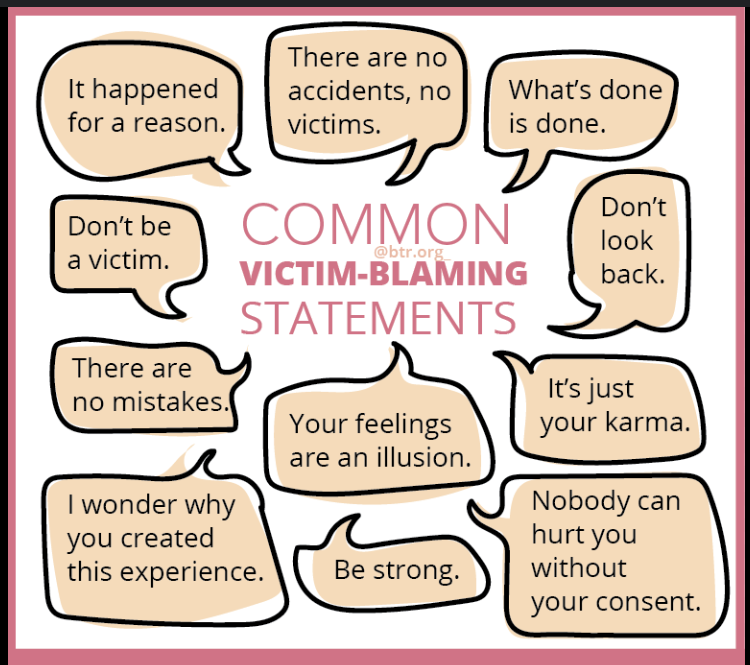
Blame the victim removes the responsibility from the perpetrator and lays it at the feet of the victim. Example: I was diagnosed with MS but since I smoked Cigarettes and Didn’t like Veggies, my family blamed me for contracting this Disease.
This Mentality allows family members to believe it was what the person did and so we can avoid helping because they did it to themselves. It provides a Rational for Abuse, Neglect and Abandonment. Yes all of this occurs and it is Deplorable, But what else is to be expected in a Decedent Society filled with Narcissists.
The Video Creators Message.
For years I have been called a liar, a quack, and a mountain of other names. I have had other content creators, make videos, making fun of me for what my son has gone through. We’re speaking about his vaccine injuries. The seizures caused by vaccine injuries, the level three autism diagnosis after the brain damage. Cause by vaccines .
Those who have vaccine injured kids, I believe you’d I see you. We should be marching we should be fighting we should be outraged! We should be fighting for not only our rights but our children’s.
And while I realize no amount of compensation could ever come close to giving us back what has been taken from us ( Our children’s lives ) These parents should be compensated! Take the money from these greedy MF who profit off our kids and give it to the parents who will be life long caregivers for a child that is now all but a vegetable from vaccines.
I thank God every day I’ve been able to help my son’s body heal from the damage done by vaccines but I know that healing isn’t linear and many parents will never have the privilege I have. The privilege of hearing their child speak.
I am absolutely outraged that more people are not outraged at everything that is coming to light. Us OG moms are not surprised. We have known for years that vaccines cause harm because we have seen it with our own eyes. After 2020 you would think more people Would open their eyes why are you still choosing to be blind?
If you are trying to help your child from these things, detox as best as you can,
.
All Vaccines Are Poisons Not Things To Inject Into Anyone, Ever!
The “blame the victim” fallacy occurs when a person is held responsible for their own harm or suffering, instead of the perpetrator. This reasoning unfairly shifts blame to the victim, often ignoring the actions of the aggressor and the environmental factors at play. It can be used as a coping mechanism by suggesting that if victims are at fault, others can avoid similar fates, but it can also retraumatize survivors, deter them from reporting crimes, and reinforce harmful stereotypes.
How it works
Redirects responsibility: The fallacy places blame on the victim for their actions, behavior, or circumstances rather than on the person who committed the harm.
Employs false reasoning: It often relies on myths and misconceptions, such as believing that a person’s clothing or attitude could “invite” an attack.
Appears in various contexts: While particularly prevalent in cases of sexual assault, it can also be seen in other situations, such as blaming a homeowner for a burglary because they didn’t lock their doors or blaming a bullied student for not fighting back.
Stems from psychological biases: One key factor is the {just-world fallacy}, which is the comforting but false belief that people get what they deserve. Therefore, if something bad happened to someone, they must have done something to deserve it.
Consequences of victim blaming
Retraumatization: It can significantly worsen the trauma for survivors, potentially halting or prolonging their healing process.
Discourages reporting: Victims may be less likely to report a crime if they fear being blamed and shamed for it.
Emboldens perpetrators: When victims are blamed, it can give perpetrators a sense of impunity and make them feel they can act without consequences.
Reinforces harmful norms: It helps perpetuate a culture where violence is normalized and excused, particularly in the context of sexual violence
Communicating with disabled people – let’s discuss the connotations
Language is by no means perfect. The words we use to talk about disabled people can alienate those individuals who are already alienated by society. So, let’s take a minute and reflect: what do we mean by ‘inclusive language’ when talking about disabilities?
Descriptivism vs prescriptivism
When talking about language, one must avoid the danger of prescriptivism. Prescriptivism is the tendency to argue that there is right or wrong language, that certain words are wrong and other words are correct. This prescriptivist approach, aiming to prescribe certain words and dismiss others, is widely criticised amongst linguists. Our study of language is most fruitful when it is descriptive. A descriptive approach aims to describe and discuss the vocabulary of a language, instead of making a judgment on which words are ‘correct’ and which ones ‘wrong’. In this article, I will engage in descriptivism. I will not provide you with a list of inclusive and non-inclusive words. I will simply guide you through different words, describe their connotations, and initiate a conversation as to which words might be more inclusive than others. There are no right or wrong answers, but exploring the connotations of different words can help you distinguish the more inclusive terminology from the less inclusive. So let’s get describing.
The evolving language and the changing connotations
Our society is becoming more sensitive to the use of language and the connotations of different words. A look back to 50 years ago sheds light on some of the non-inclusive words which we are now abandoning. In an article for the Guardian, Penny Pepper talks about the language she was subjected to as she was growing up as a disabled person in 1970s Britain (Pepper, 2016). She describes how people would call her ‘delicate’, a very disempowering euphemism to talk about disability. She recalls being called a spastic, which she describes as ‘abusive language’. Growing up in a society which labelled disabled kids as ‘little handicaps’ and ‘invalid’ was surely not empowering. British society has done a good job, in that we have now shifted away from using such terminology. However, some of these words remain in the public domain. For instance, Penny recalls how her elders found her fit for a ‘special school’; she was disabled after all! This word still seems to be present in 21st century English. Educators, researchers and the government still talk about SEND – Special Educational Needs and Disability. But how can we ever hope to normalise disability if we continue referring to disabled people as ‘special’? The spotlight is not fun, and turning heads is not our aspiration.
Victim blaming
The words we use to talk about disabled people can often stray into victim blaming. Victim blaming occurs when our language incorrectly assigns the blame for discrimination to disabled people themselves. It’s very common to talk about that friend who ‘couldn’t attend a seminar because of his disability’. It’s very common to talk about that student who ‘failed her university degree because of her mental health problems’. Both of these expressions engage in victim-blaming because they suggest that what prevents disabled people from participating in every-day events is their disability itself. However, under the social model of disability, when disabled people are excluded from every-day events, the fault belongs to society, institutions, or other external parties who have failed to create an inclusive experience for disabled people (Oliver, 1990). Arguably, that friend couldn’t attend a seminar because the seminar room did not have level access. Arguably, that student failed her university degree because the university’s procedures were not flexible enough to offer multiple deadline extensions. In both these cases, the blame is on the providers of education. It is not on disabled people.
In recognising that societies, governments and institutions are responsible for the exclusion of disabled people, we do justice to the passive structure of the phrase ‘disabled person’. Every individual is able to access, participate in and succeed in every opportunity, provided that they are not disabled by non-inclusive design features. A perfectly able person then fails to engage in an every-day activity not because of their disability, but because they were disabled by society. It is essential to constantly monitor our language so that we assign the blame to external parties, instead of blaming disabled people for the exclusion imposed on them by others.
‘Disabled person’ or ‘a person with disability’? When different preferences muddy the waters
Higher education policymakers constantly experience the dilemmas of language and disability. Universal Design proves tricky to achieve, especially when disabled communities across the world do not agree on a fixed set of words to talk about disability. Whereas talking about ‘disabled people’ makes the point that external forces have disabled otherwise able individuals, talking about ‘a person with disability’ can fulfil other emotions and identity needs. Those who choose to call themselves ‘a person with disability’ instead of ‘disabled person’ often explain that, by using people-first language, they are emphasising that they are human before they are disabled – and should be treated as such. It is their way of demanding equity, by emphasizing that, at the very core, they are human beings, and additional characteristics such as disability are secondary. Hence, the challenge for a policymaker would be to decide which of the two expressions to adopt in official policies, when preference sways in both directions.
When minor tweaks go major miles
During my many years receiving higher education in the UK, I constantly shifted between an exhausting surge of self-doubt and my inner voice reminding me that I was far from being the problem. It is difficult to feel empowered when so much of the language we are exposed to promote a medical model of disability. How am I to feel strong and self-sufficient if I need to ‘get a doctor’s approval’ in evidence of my ‘mental health disorder’? How am I to feel empowered if a medical professional, far removed from my mind and my body, is more trusted than I am in determining my eligibility for that deadline extension? And how do I prove that I had a gruesome childhood if my home country doesn’t believe in mental health, and one cannot get a mental health note from a doctor without being labelled by society as a crazy lunatic?
If the language we use describes our experiences as disorders, as abnormalities, then what’s stopping disabled people from internalising all of that pity? Haegele and Hodge (2016) warn us against ‘learned helplessness’. Society can impose feelings of helplessness on otherwise perfectly independent individuals by using language which belittles, disempowers and pities. In the higher education context, minor tweaks to language can really go a long way. When talking about learning support, is it more empowering to talk about learning difficulties, learning disorders, or learning differences? If the true ambition of higher education is to promote diversity, surely we must adopt the expression learning differences. If we are to embrace neurodiversity, the biggest risk lies in using language which promotes a neuro-typical norm and a neuro-divergent outsider.
A very empowering day of my life was when I heard my counsellor use the term ‘disordered eating’ to describe my binging tendencies. He, instead of classifying my experiences as an ‘eating disorder’, chose to talk about my ‘disordered eating’. If we analyse the structures of the two variants, we can see that ‘disordered eating’ merely suggests that my eating pattern is lacking structure. On the other hand, ‘eating disorder’ suggests that I have a disorder, a sickness. Such minor tweaks to our language can go a long way in fighting that learned helplessness and in empowering disabled individuals.
It is heartening to see that fixed expressions with worrying connotations are now being replaced with less loaded alternatives. King’s College London’s disability support team are shifting away from the term ‘disclosing a disability’. A disclosure is commonly associated with an act which can be embarrassing, which has been hidden for a long time. You must have heard of Disclosure and Barring Service! Why, then, stick to an expression which, instead of offering support and comfort to a student, perpetuates feelings of shame and exposure? Bearing this in mind, King’s is now undergoing a culture change. More and more people are talking about students ‘sharing’ their disability, which is much less loaded than variants such as ‘disclosing’ or ‘declaring’.
Similarly, mental health support services at King’s are now moving away from the idea that students ‘commit’ suicide. The expression ‘to commit’ is often used alongside criminal or shameful acts, as seen by phrases such as ‘to commit a crime’, ‘to commit an offence’ and ‘to commit a sin’. Why, then, use language that criticises those who are suffering to the extent of self-harm? Moving to less loaded variants such as ‘attempting suicide’ and ‘completing suicide’ is most welcome. Such alternative expressions can play a big role in reducing feelings of embarrassment and shame experienced by those going through severe mental distress.
It is difficult to get the language right, that’s for sure. We might even claim that English does not have the perfect word inventory to enable us to talk non-judgmentally about disability. But starting to think about language is a crucial step to getting there. As there are no universally agreed variants, it remains crucial to ask rather than assume, as every person will be comfortable with different terms.
“Victim blaming” was a common and significant phenomenon during the COVID-19 pandemic, where individuals and groups were held partially or wholly responsible for their own or others’ infection or the spread of the virus.
Key Aspects and Examples
Individual Behaviors: People were frequently blamed for behaviors perceived as “irresponsible” or a “moral violation” of public health guidelines, such as not wearing a mask, not social distancing, traveling, or attending social gatherings.
Vaccination Status: A major point of contention was the vaccination status of victims. Studies found that people tended to attribute more blame to unvaccinated COVID-19 victims than to vaccinated ones, often assuming the unvaccinated “could have done otherwise” to prevent their illness.
Social Identity and Xenophobia: Blame and stigma were often directed at specific social, ethnic, or religious groups, particularly in the initial stages of the pandemic.
Asian people were widely targeted by xenophobic remarks and hate crimes, blamed for the virus’s origin in Wuhan, China.
Specific religious communities or individuals (like a pastor in South Korea who lied about their travel history) faced intense public shaming and online attacks.
“The posh” (wealthy travelers) were also an early target of blame for bringing the virus into communities.
Socio-political Factors: The tendency to blame victims was tied to political orientation and trust in government. Some political leaders used blame as a rhetorical tactic to deflect from systemic issues or government policy shortcomings, shifting the focus to individual responsibility.
Psychological Mechanisms: Victim blaming often stems from a psychological need to believe in a “just world” where bad things happen to “bad” people, which helps individuals maintain a sense of control and reduces their own fear of the unexpected risk.
Consequences
Victim blaming had negative consequences: it caused suffering for patients, led to social exclusion and discrimination, and discouraged people from seeking testing or treatment for fear of being shamed, which ultimately hindered public health efforts to control the pandemic


0 Comments