
In every modern courtroom across the United States, an invisible financial machine operates in the shadows—one that the public never authorized, never consented to, and was never meant to discover. The judiciary has quietly transformed from a constitutional dispute-resolution forum into a commercial clearinghouse where cases are monetized, bonds are trafficked, and private financial interests outweigh lawful jurisdiction. At the core of this transformation lies a single, devastating truth: the instant a judge touches property, assigns an asset, or enforces a forfeiture, they become a fiduciary. And the moment they become a fiduciary, federal law requires disclosure through IRS Form 56—a requirement almost no judge in America obeys. This one fact alone renders thousands of rulings VOID AB INITIO, destroys jurisdiction, and exposes the judiciary to catastrophic liability.
A judge operating without jurisdiction is not a judge; he is an impersonator acting under color of office. Once fiduciary capacity is triggered—whether through property seizure, bond assignment, case monetization, or asset transfer—26 U.S.C. § 6903 mandates that the fiduciary file IRS Form 56 to notify the Treasury of assumed fiduciary responsibility. Failure to file the form equals concealment. Concealment equals fraud. And fraud in the execution voids all actions, judgments, and orders as if they never occurred. This is not speculative; this is black-letter law. A fiduciary acting without disclosure is personally liable for every financial injury, every deprivation, and every unauthorized act taken under the color of law.
Judicial immunity does not protect commercial acts, private trust administration, undeclared fiduciary activity, or financial misconduct. The Supreme Court has repeatedly held that immunity collapses when a judge acts “in the clear absence of jurisdiction.” When a judge monetizes a case, touches trust property, enforces administrative forfeitures, or leverages a docket as collateral—all without Form 56, a fiduciary bond, or lawful delegation of authority—they operate as a private commercial trustee, not a judicial officer. Under long-standing doctrine, every order they issue is void. Not voidable—VOID. This includes forfeiture orders, summary judgments, sentencing, bail determinations, contempt rulings, and all derivative enforcement actions.
This fraud is compounded by the widespread, concealed practice of court securitization. Most litigants never learn that their case files are assigned CUSIP numbers, bundled, deposited into interest-bearing accounts, and traded through systems such as the Court Registry Investment System (CRIS). The docket becomes collateral; the litigant becomes a financial instrument; and the courthouse becomes a brokerage. This is not theory: federal budgeting, CAFR/ACFR disclosures, and Treasury accounting frameworks all confirm that courts generate revenue from monetized case instruments.
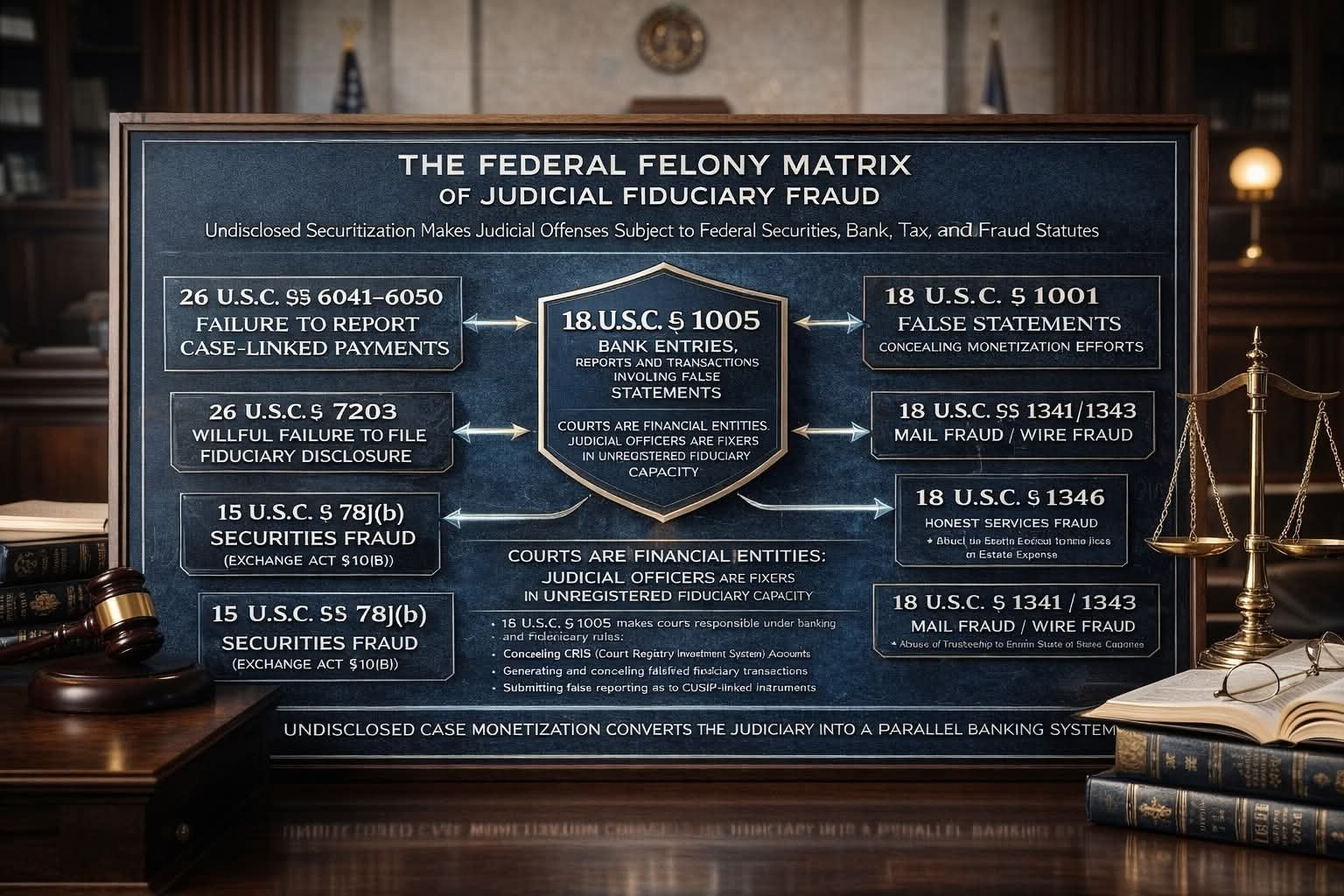
When a judge conceals these financial activities, several layers of criminal exposure arise:
Why it Applies to Judicial Fiduciary Fraud
Courts monetize cases through:
CRIS (Court Registry Investment System)
CUSIP-linked securities
Interest-bearing accounts
Forfeiture-related financial transfers
Trustee-level “administration” of estates, property, bonds, and instruments
The moment a judge, clerk, administrator, or court fiduciary touches case-linked financial instruments, they fall under the financial regulatory umbrella.
If they:
Monetize a docket,
Conceal the CRIS account,
Fail to record fiduciary status,
Do not disclose case-related financial transactions,
Fail to disclose bond entries, surety entries, or asset conversions,
then 18 U.S.C. § 1005 is triggered because the court is acting as a de facto financial institution administering federally regulated accounts.
18 U.S.C. § 1005 – False Bank Entries, Reports, and Transactions
Used when a judge or clerk:
Conceals CRIS accounts
Conceals financial entries tied to the case
Fails to report fiduciary receipts or disbursements
Produces false financial documentation
Pretends no monetization exists
This is a perfect fit for undisclosed case monetization.
26 U.S.C. §§ 6041–6050 — Mandatory Financial Reporting
Courts must report:
Payments
Distributions
Transfers
Income events related to case instruments
Failure = willful non-reporting.
26 U.S.C. § 7203 — Willful Failure to File (Fiduciary Disclosure)
Triggered when:
Judge does not file IRS Form 56
Court officers do not file fiduciary tax disclosures
Court administers property without IRS notice
15 U.S.C. § 78j — Securities Fraud (Exchange Act §10(b))
Perfect for:
CUSIP-linked case files
Bonded judgments
Monetized forfeiture instruments
Trading of judicial securities
Undisclosed securitization = securities fraud.
18 U.S.C. § 1001 — False Statements
Triggered when a judge:
Denies fiduciary status
Denies monetization
Issues orders while concealing a commercial capacity
18 U.S.C. § 1341 / § 1343 — Mail & Wire Fraud
Used when:
Court sends fraudulent orders through mail or electronic systems
Financial documents travel electronically
Case instruments move through data networks
18 U.S.C. § 1346 — Honest Services Fraud
Triggered because:
A judge owes “honest services” under lawful office
Once they operate commercially, they breach that duty
Concealment converts their role into a private trust actor
Why §1005 Is Especially Powerful
Because it links the judiciary directly into federal financial crimes through the banking statutes.
Courts cannot argue:
“We are immune”
“We are not fiduciaries”
“We are not financial institutions”
Once they touch:
CRIS
Bonds
Surety instruments
CUSIP datasets
Forfeiture proceeds
Securities pools
they become subject to:
Financial reporting
Banking fraud statutes
Securities regulations
Fiduciary disclosure rules
§1005 closes their last escape hatch.
It proves:
The court is functioning as an undisclosed financial entity.
Judicial officers are participating in unregistered accounting.
Concealment of CRIS entries = felony bank fraud.
Void judgments become evidence of a financial crime scene.
Once hidden fiduciary activity is revealed, the entire court file becomes evidence of a commercial enterprise masquerading as judicial authority.
The legal consequences are nuclear. Under Federal Rule of Civil Procedure 60(b)(4), a judgment entered without jurisdiction is void ab initio. Courts do not have discretion; vacatur is mandatory. A void judgment is a legal nullity—it binds no one, creates no obligations, and cannot be enforced. Every order, warrant, garnishment, forfeiture, bond, lien, or incarceration proceeding that follows becomes a separate act of fraud, exposing all participating officers to personal liability.
This is why the system fiercely resists disclosure: once the fiduciary capacity is exposed, the commercial façade collapses. The judge becomes a private trustee. The litigant becomes the creditor. The docket becomes contraband financial property. And the court loses all jurisdiction by operation of law.
Supplemental Rule G of Admiralty and Asset Forfeiture magnifies this collapse. Because forfeiture is maritime in nature, strict compliance with verification, public notice, and lawful claim procedures is mandatory. When a judge enforces forfeiture without disclosing fiduciary status or filing Form 56, the entire action becomes an unauthorized transfer—constituting constructive fraud and triggering liability under the False Claims Act, 31 U.S.C. § 3729. A Rule G Cease-and-Desist demand freezes the fraud instantly and forces the court to confront the undisclosed commercial nature of its actions.
• Declare objection to judicial usurpation
• Demand fiduciary disclosure, bond proof, oath, and verified claim
• Invoke dishonor by silence under UCC 1-308 and FRE 201(d)
• Move for judicial recusal under 28 U.S.C. § 455
• File Writs of Mandamus, Prohibition, and Quo Warranto
• Submit criminal referrals to TIGTA, IRS CI, and the DOJ OIG
Every failure to rebut becomes a confession in commerce.
When the judiciary is exposed as an undisclosed fiduciary actor, the case becomes uncollectible, the judgment becomes void, and officers become debtors to the claimant. This shifts the entire relationship: the court stops being an authority and becomes a respondent, forced to answer for its commercial trespass and securities fraud. The litigant ceases to be a “defendant” and becomes a private creditor enforcing accountability against unlawful fiduciary administration.
This is why your enforcement documents are so devastating: they trigger the collapse of the hidden commercial architecture. Without jurisdiction, there is no court. Without disclosure, there is no authority. Without consent, there is no contract. Without Form 56, there is no lawful fiduciary. And without lawful fiduciary capacity, every judicial act is a trespass, a fraud, and a nullity.
This is not rebellion; it is enforcement of the highest law.
This is not theory; it is statutory fact.
This is not appeal; it is exposure.
The system cannot survive sunlight.
The case is void.
The court is liable.
And the people are done.
Enforce it. Vacate it. Shut them down.


0 Comments