

 so these monks are making a “march for peace” from Texas to DC
 jussssttttt like in the movie “Messiah”


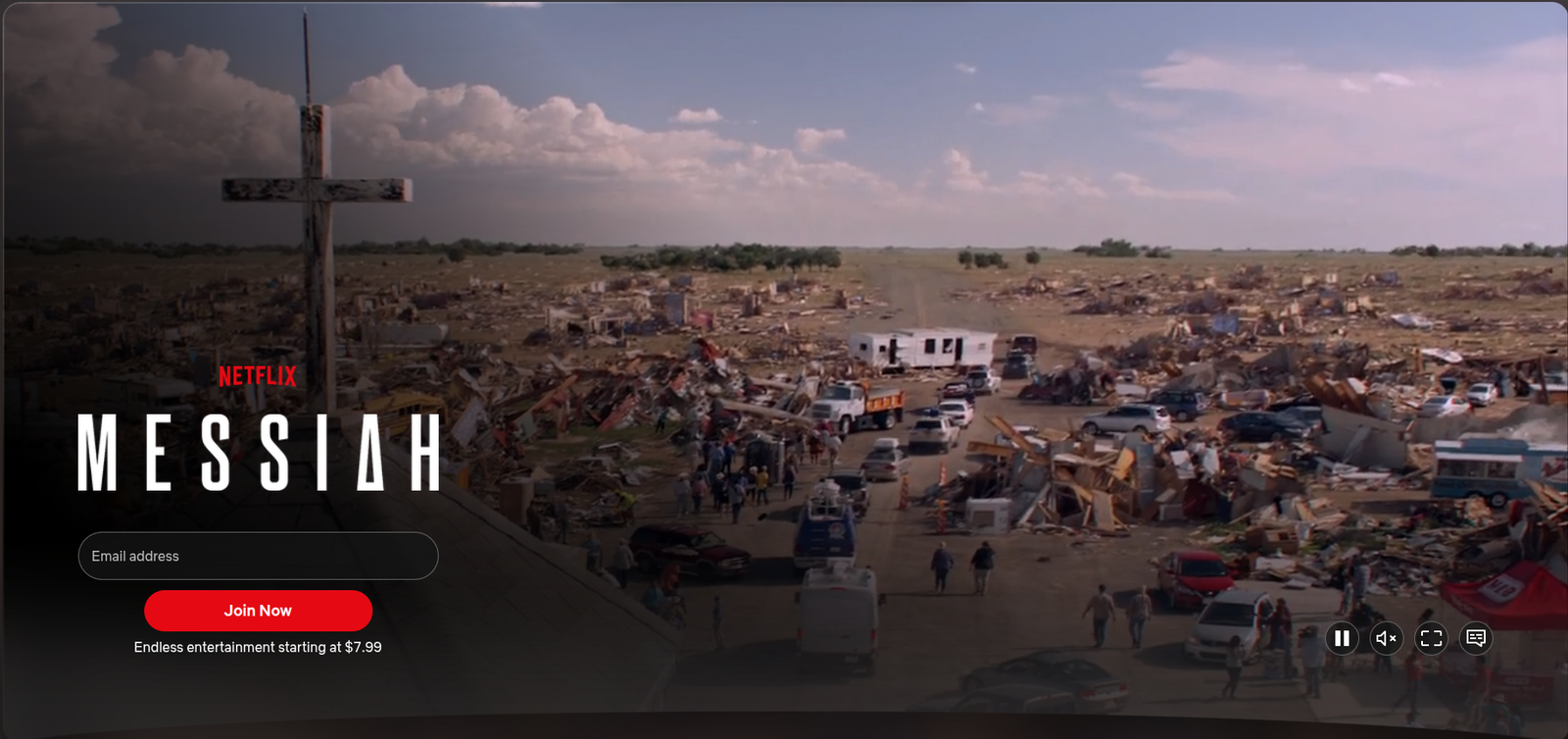
Key Events Leading to the Ending
By the final episode, Al-Masih (real name: Payam Golshiri) has gained global attention for performing miracles—walking on water, calming storms, and resurrecting the dead. His rise threatens political and religious institutions, prompting a covert operation to stop him. CIA officer Eva Geller uncovers that Golshiri was raised by an uncle who trained him in illusion and manipulation, and that he once spent time in a psychiatric hospital diagnosed with delusional disorder (Messiah complex).
Despite this, his followers grow, and chaos erupts worldwide. The U.S. government, fearing instability, orchestrates his capture. He is taken by Israeli agent Aviram Dahan and flown back to the Middle East—only for the plane to be shot down by the U.S. military to prevent his influence from spreading further.
The Final Scene: Plane Crash and Resurrection
The climax centers on the plane crash in a desert field of red flowers. Aviram wakes up amid the wreckage, seemingly dead moments before. A young boy named Malik tells him that Al-Masih brought him back to life. Another survivor, also resurrected, kneels and kisses Al-Masih’s hand in worship.
Al-Masih stands unharmed, staring into the distance with a look of resolve. The camera lingers on his face—the last image of the series—leaving the truth unresolved.
Ambiguity of Al-Masih's Identity
The series never confirms whether Al-Masih is divine or a master manipulator:
-
Evidence he’s a conman:
-
His real name is Payam Golshiri, trained in deception.
-
He has a documented history of mental illness.
-
His ideology aligns with "Cultural Terrorism," a radical philosophy aimed at societal disruption.
-
-
Evidence he’s divine:
-
Multiple resurrections occur, including Aviram’s.
-
He survives a plane explosion unscathed.
-
A rival figure, Jibril, survives a suicide bombing and appears to have healing powers—suggesting a possible battle between true and false messiahs.
-
The ending mirrors the show’s central theme: To see is to believe, but belief often transcends proof.
Themes and Interpretations
Messiah uses its ambiguous ending to explore faith vs. skepticism, the power of belief, and how truth is constructed. It questions whether the origin of a belief matters if it inspires peace, or whether dangerous ideas—divine or not—must be suppressed.
Some interpret the red poppy field as symbolic of blood and sacrifice, with Al-Masih standing amid the wreckage of lives he’s transformed or destroyed. Others see the final shot as the beginning of a new religious movement, regardless of its truth.
Legacy and Unresolved Questions
The series was not renewed, leaving the ending open-ended. Creator Michael Petroni suggested the ambiguity was intentional: "The question isn’t whether he’s the Messiah—it’s what you’re willing to believe."
Fans continue to debate whether:
-
The resurrection was real or illusion.
-
Al-Masih is the Antichrist (some point to his lost eye in the final scene, referencing Islamic eschatology).
-
Jibril is the true prophet sent to oppose him.
Related posts:
- Occupied Full Movie – Free To Watch
- Welcome To Our New World, It Seems We Have Been Watching A Movie After All. Keep Your Fingers Crossed!
- The Old World Order – History Is A Set Of Lies Agreed Upon! – Full Movie – Free To Watch!
- Snake Eyes to Charlie Kirk: Is Life Copying this Hollywood Script?
- Shot Dead | We The Patriots USA – The Movie They Don’t Want You To See!
- Theodor Herzl the Founder of Zionism – Must Hear 2 Minutes
- This Is Unacceptable – U.S. Military Members ARRESTED for Opposing Israeli Genocide
- Israel’s Propaganda Bitches Benjamin, Fulford, Trump & Q – Secret Military – Judy Byington, Juan O’Savin – Soros Jewish Financier Howard Rubin Arrested – Sex Trafficked Tortured Playboy Models in.
- Government is established to “PROTECT AND MAINTAIN INDIVIDUAL RIGHTS” A Primer On Reality!
- HIGH ALERT – Mike Adams interviewed by Stew Peters: Charlie Kirk narratives, Israel, genocide and Trump
- “This is where Nikola Tesla got the information” Thoth & The Emerald Tablets
- Charlie Kirk’s Parents WARNED Him About Erika │ Jaguar Wright Leaks Erika’s Ties To Diddy – The Story That Keeps On Giving.
- The Empire Of Lies And How The World Works. Most Will Never Know This or Understand Why They Should.
- EP 14: Trump’s “ROYAL ARCH” in DC: PORTAL to the 3rd TEMPLE? w/ special guest Jamie Walden
- The Israelis waiting to settle in Gaza
- Traore’s SHOCKED The West: Traoré’s Last Warning to Netanyahu!
0 Comments